Fiber Color Code Past 12: Tubes, Tracers, Binders and Ribbons
Everyone knows blue, orange, green, brown. The mistakes happen past fiber 12: tracers, double dashes, binder groups and ribbons. A practical guide to identifying fibers in high-count cable.
In this article
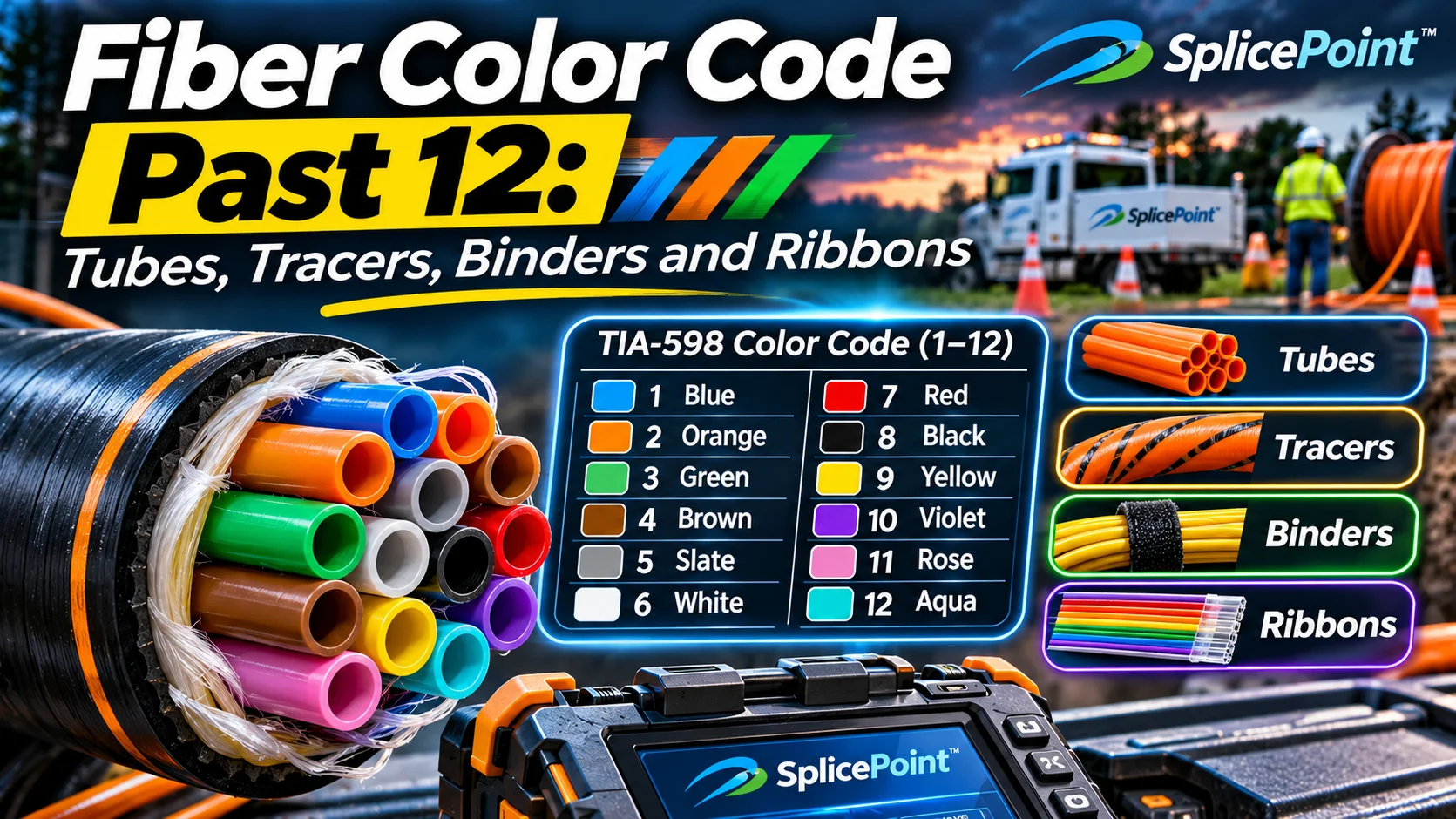
Every splicer knows the first twelve: blue, orange, green, brown, slate, white, red, black, yellow, violet, rose, aqua. That sequence comes from the TIA-598 standard and it's the backbone of fiber identification across North America.
The mistakes don't happen in the first twelve. They happen at fiber 13, at tube 13, and in 432-count cable where the colors start over inside every binder. Here's how identification works past the basics, and where crews get caught.
The base sequence (fibers and tubes)
The same twelve colors identify both fibers and buffer tubes, in the same order:
- Blue
- Orange
- Green
- Brown
- Slate
- White
- Red
- Black
- Yellow
- Violet
- Rose
- Aqua
In a 144-fiber loose tube cable with 12 tubes of 12 fibers, fiber 1 is the blue fiber in the blue tube, and fiber 144 is the aqua fiber in the aqua tube. Strand number = (tube number − 1) × 12 + fiber position in the tube.
Fibers 13 to 24: tracers
When a tube holds 24 fibers, fibers 13 through 24 repeat the twelve colors with a tracer, a black dash or stripe on the fiber. Fiber 13 is blue with a black tracer, fiber 20 is black with a tracer in a contrasting color (usually yellow, since a black mark on a black fiber wouldn't show).
Fibers 25 to 36: this is where it varies
This is where crews get burned. There's more than one convention in the field:
- Dash schemes (the TIA-598 approach): 13–24 get a single black dash, 25–36 get a double dash.
- Stripe schemes used by some manufacturers: 13–24 get a black stripe, 25–36 a red stripe, 37–48 a green stripe, with a different stripe color where the stripe would match the base color.
Two cables from two manufacturers on the same job can mark fiber 30 differently.
The rule: never assume. Pull the manufacturer's spec sheet for the exact cable on the reel, and write the marking scheme on the splice sheet before the first closure is opened.
High-count loose tube: binders
Once a cable has more than twelve tubes, the tubes are grouped into binder units, wrapped with colored binder threads or tapes. The binders follow the same twelve-color sequence, and the tube colors restart inside each binder.
So in a cable with binders of six tubes, the "blue tube" exists in every binder. Saying "blue tube, orange fiber" is meaningless until you say which binder. The full address is binder, then tube, then fiber.
Common mistakes:
- Identifying a tube by color alone in a multi-binder cable
- Losing track of the binder thread when the sheath is stripped back far
- Splice sheets that list strand numbers without binder and tube, so the next splicer can't verify them
Ribbon cable
High-count cables (432, 864, 1728 and up) are often ribbon construction: fibers bonded side by side in flat ribbons, typically 12 fibers wide. Within a ribbon, fibers follow the standard twelve colors. Ribbons themselves are identified by printing or numbering on the ribbon, and are grouped into subunits.
Ribbon splicing changes the workflow: you mass-fusion splice a whole ribbon at once, so a ribbon identification error moves twelve fibers at a time. Verify the ribbon ID twice before you cleave.
Rollable or flexible ribbons add another wrinkle: they're bonded intermittently so they can fold, which makes high-count cables smaller, but they still identify by ribbon marking plus fiber color.
What to put on every splice sheet
A splice sheet that will still be useful in five years records:
- Cable ID, fiber count and construction (loose tube or ribbon)
- Marking scheme for fibers past 12 (dash or stripe, and which colors)
- Binder size, if the cable has binders
- For each splice: strand number and the physical address (binder / tube / fiber, or ribbon / fiber)
- Who spliced it and when
Strand numbers alone aren't enough, because strand numbers are what someone calculated. Colors are what the splicer actually saw. Recording both lets anyone check one against the other.
The takeaway
The first twelve colors are easy. Everything past them depends on the cable, the manufacturer and the construction. Most identification errors aren't skill problems; they're assumption problems. Confirm the scheme from the spec sheet, record it where the next splicer will see it, and write down the physical address of every fiber, not just its number.
SplicePoint generates fiber colors from the cable's actual construction, including tracer scheme, binders and ribbons, so splice sheets show the address the splicer will actually see. Take a look.
See SplicePoint on your next build
Field apps, splicing records, testing and closeout in one platform for fiber contractors.