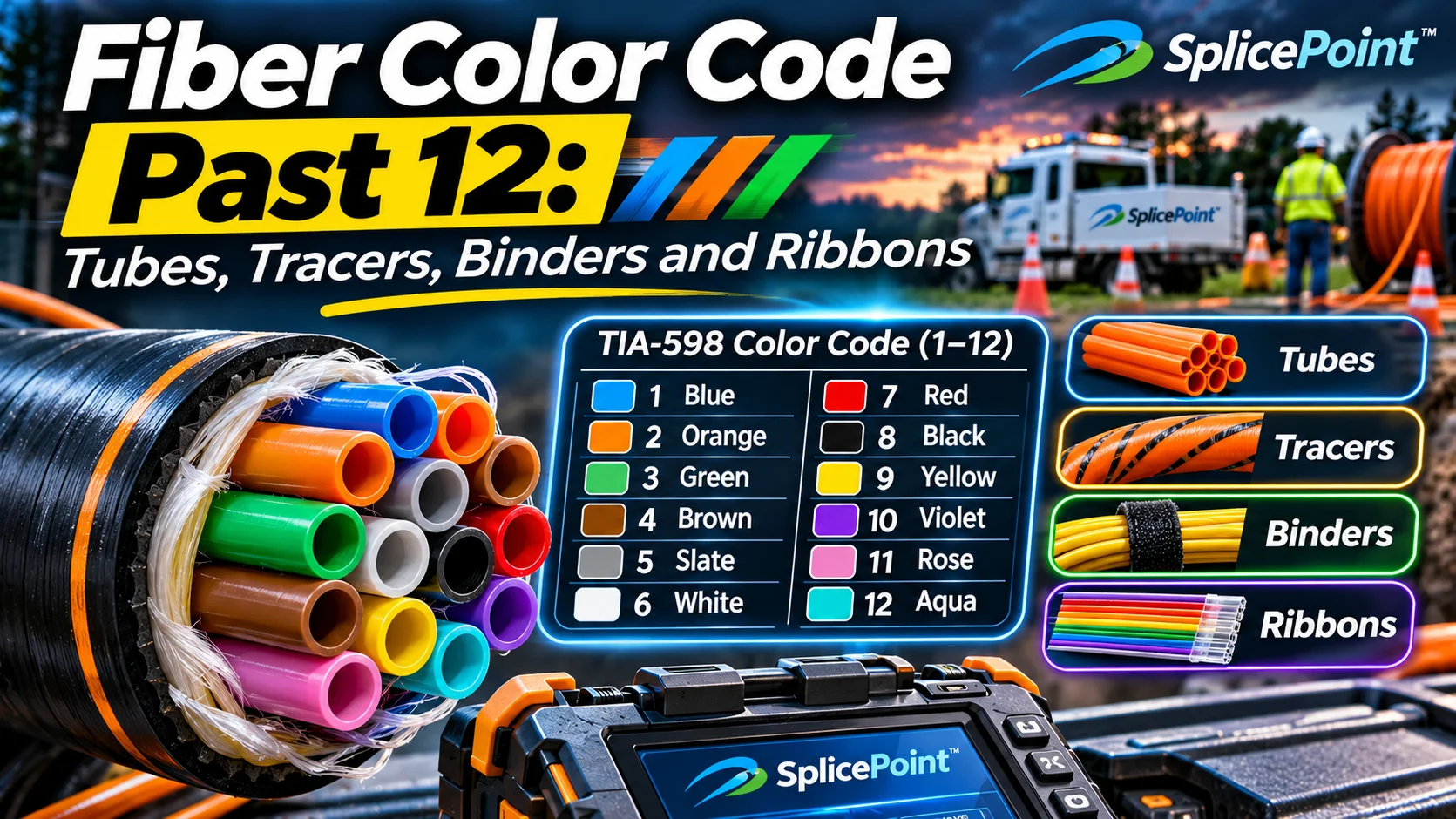
What's an Acceptable Splice Loss? When to Re-Splice and When to Leave It
The splicer says 0.02 dB. The OTDR says 0.18 dB in one direction. Do you reopen the closure? A practical guide to splice loss numbers, what causes high loss, and how to make the re-splice call.
In this article
Reopening a closure costs real time: travel, setup, opening the case, managing slack, re-splicing, resealing. Not reopening a closure that should have been fixed costs more, usually later, usually in the form of an owner rejecting your test results.
So what counts as an acceptable splice loss, and how do you make the call?
Start with the spec, not a rule of thumb
The number that matters is the one in your contract or the owner's test specification. Industry standards set an upper limit per splice (TIA-568 allows up to 0.3 dB), but project specs are almost always tighter. For single-mode fusion splices, specs commonly land somewhere around 0.10 to 0.15 dB per splice, measured as a bidirectional OTDR average.
Read the spec for three things:
- The limit: the maximum loss per splice
- How it's measured: OTDR, and in which directions
- Whether it's per splice or an average: some specs allow an individual splice to exceed the limit if the average across the span stays under it
If your spec doesn't say how splice loss is measured, ask before testing starts. It changes everything below.
The splicer's estimate is not a measurement
Fusion splicers display an estimated loss after each splice, calculated from the image of the fiber cores. It's useful for catching obviously bad splices on the spot. It is not what the owner will accept, and it can be optimistic.
A splicer showing 0.01 dB and an OTDR showing 0.20 dB at the same event is common. The splicer can't see a bend in the tray or a problem in the heat shrink protector.
Use the estimate to decide whether to redo a splice right now. Use the OTDR to decide whether it passes.
One direction lies. Both directions tell the truth.
When two fibers with slightly different mode field diameters are spliced, an OTDR shooting from one end can show a gain (a "gainer") and from the other end an exaggerated loss. Neither number is the real splice loss. The average of both directions is.
That's why most specs require bidirectional testing for splice loss. A splice that reads 0.22 dB from the A end and −0.08 dB from the B end has an actual loss of about 0.07 dB. It passes. Re-splicing it based on the one-way number would waste a truck roll.
What causes high splice loss
When the bidirectional average really is high, the usual causes are:
- Bad cleave: angle too steep or a chipped end face. The most common cause.
- Contamination: dust or residue on the fiber or in the V-grooves.
- Core misalignment: worn electrodes, dirty V-grooves or a splicer that needs calibration.
- Bends in the tray: fiber routed too tightly in the splice tray or pinched by the lid. This one shows up after the splice, so the splicer's estimate looks perfect.
- Heat shrink problems: a protector that shrank around a bend or trapped debris.
A tip for spotting bend problems: macrobend loss is much worse at 1550 nm than at 1310 nm. If an event is fine at 1310 and noticeably higher at 1550, suspect a bend in the tray before you suspect the splice. Fixing the routing may be all it takes, with no re-splice needed.
Making the call
A practical decision path:
- Bidirectional average within spec? Leave it. Document it.
- Over spec at 1550 but fine at 1310? Check fiber routing in the tray first.
- Over spec in both wavelengths, both directions averaged? Re-splice.
- Spec allows averaging across the span, and this splice is slightly over while the span average passes? It may be acceptable. Confirm the spec language and document the decision.
- Several high splices in the same closure? Look at the splicer (electrodes, calibration, cleaver blade) before re-splicing everything.
The worst outcome is the one in between: knowing a splice is marginal, leaving it without documentation, and having the owner find it during acceptance.
Prevent it at the splice
Most re-splices are avoidable:
- Clean the cleaver and check the blade position on schedule, not when cleaves go bad
- Keep V-grooves and electrodes clean, and run arc calibration at the start of the day and when conditions change
- Reject any splice the splicer estimates above your internal threshold, right then, while the closure is open
- Route fiber in the tray with the minimum bend radius in mind, and check it before closing the lid
- Shoot the closure before you leave the site when you can
SplicePoint averages bidirectional OTDR events and checks each splice against the project's own acceptance criteria, so you know which closures need a return trip before the crew leaves the area. See it in action.
See SplicePoint on your next build
Field apps, splicing records, testing and closeout in one platform for fiber contractors.