Why OTDR Testing Should Be Bidirectional: Gainers, Phantom Losses and Real Numbers
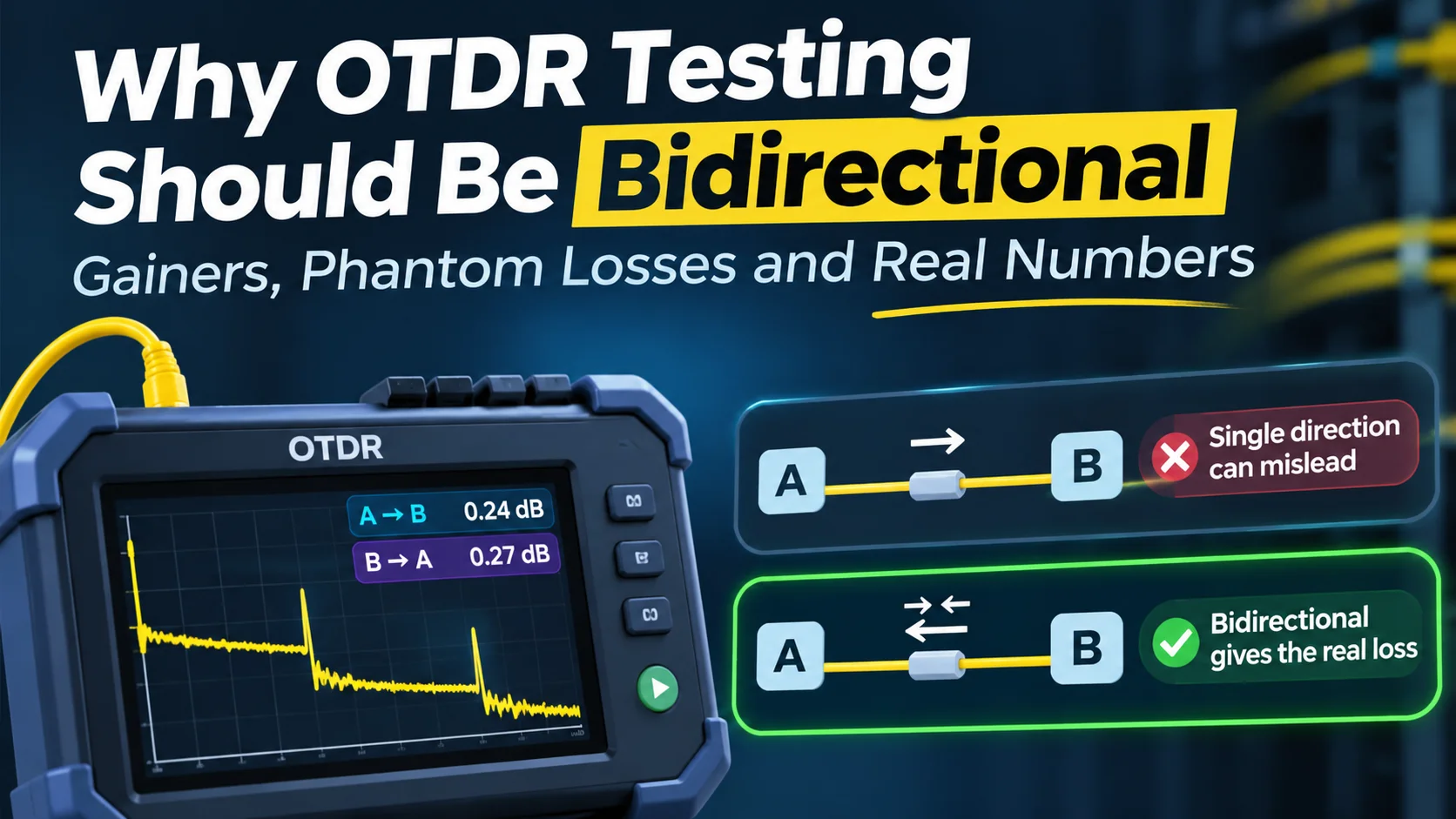
A one-way OTDR shot can make a good splice look bad and a bad splice look good. Here is why bidirectional testing is the standard for splice loss, and how to run it without wasting a day.
In this article
If you've ever looked at an OTDR trace and seen a splice that gains light, you've met the reason bidirectional testing exists. Fiber doesn't amplify anything. The trace is telling you something true about the fibers, just not the thing you think it's telling you.
What a one-way shot actually measures
An OTDR doesn't measure loss directly. It sends pulses down the fiber and measures the light scattered back (backscatter) over distance. A splice shows up as a step in that backscatter level.
The problem: the amount of backscatter depends on the fiber itself, especially its mode field diameter (MFD), the effective size of the light-carrying region. Two fibers that are both perfectly in spec can have slightly different MFDs, especially if they come from different manufacturers or production runs.
When the light crosses a splice from one fiber into another with a different backscatter level, the OTDR sees the step change and reports it as loss, or gain, even though part of that step is just the difference between the two fibers.
Gainers and exaggerated losses
Shoot the same splice from both ends and you get two different numbers:
- From the A end: −0.08 dB (a gainer)
- From the B end: 0.22 dB
Neither is the real splice loss. The MFD effect adds to the reading in one direction and subtracts in the other by the same amount. Average the two and it cancels:
(−0.08 + 0.22) ÷ 2 = 0.07 dB
That's the actual splice loss. A one-way test from the B end would have failed a good splice. A one-way test from the A end would hide a bad one, because a real 0.25 dB splice can show up looking like 0.05 dB from the "wrong" end.
That's why most owner specifications require bidirectional averaging for splice loss acceptance, and why one-way results get rejected.
Run it right the first time
Bidirectional testing doesn't have to double your test time if it's set up properly.
Use launch and receive cables. An OTDR can't see clearly right at the start of the fiber (the dead zone), so without a launch cable you can't measure the first connector. Without a receive cable at the far end, you can't measure the last one. Use both, at the lengths your spec calls for.
Match your settings in both directions. Same wavelengths, same pulse width, same averaging time, same index of refraction. Mismatched settings produce events that won't line up when you average.
Test the wavelengths the spec requires. Usually 1310 and 1550 nm on single-mode. Some specs add 1625 nm, which is very sensitive to bends.
Name files consistently. Cable ID, fiber number, direction and wavelength in every file name. Averaging is impossible when you can't pair the A→B file with its B→A partner. Bad file naming causes more rework than bad splices.
Keep the raw .sor files. The PDF summary isn't enough for most owners. They want the trace data.
Common mistakes
- Averaging the wrong events. On a long span with many splices, events must be aligned by distance before they're averaged. Averaging splice 4 from one end with splice 5 from the other gives garbage.
- Treating gainers as errors. A gainer in one direction is normal. It's only a problem if the bidirectional average is out of spec.
- Testing before the closure is finished. Bends introduced when the closure is dressed and sealed won't be in the trace.
- One wavelength only. A splice that passes at 1310 and fails at 1550 is usually a bend. You'll never see it with one wavelength.
What this means for your schedule
Bidirectional testing means getting equipment to both ends of the span. On a plan, that's a logistics decision: two techs with two OTDRs, or one tech making two trips, or loopback testing where the spec allows it. Decide it at the start of the job, not when the owner rejects the first set of results.
SplicePoint pairs A→B and B→A results per fiber, averages the splice events, and grades each fiber against the project's acceptance criteria, so a one-way gainer never passes or fails a fiber on its own. Book a demo.
See SplicePoint on your next build
Field apps, splicing records, testing and closeout in one platform for fiber contractors.